





 Local Weather
 Weather Forecast
 Weather Warnings
 Weather for Fishermen
 Weather for Marine
 Weather for Aviation
 Weather Monitoring Imagery
 GIS Weather Service
 Tropical Cyclone
 China Weather
 World Weather
 Climate Information Service
 Warnings & Signals Database
 Statistics of Special Weather Events
 Monthly Weather Summary
 Climate Change
 El Nino and La Nina
 Earthquakes
 Tsunamis
 Tide
Tide Geomagnetism
 Space Weather
 Weather Information for Astronomical Observation
 Interactive Sun Path Diagram
 Astronomical Data
 Interesting Astronomical Phenomena
 Time Services
 Calendar
 Almanac
 Real time Radiation level in Hong Kong
 Understanding Radiation
 Radiation Monitoring, Assessment and Protection
 Environmental Radiation Monitoring Programme
 Daya Bay Contingency Plan
 Related Sites
 Schools
 Travel
 Sports
 Outdoor Photography
 CWOS
CWOS Senior Citizens
 Stargazers
 FoOb
FoOb My Little Observatory
 Interactive Map of Storm Damage by Mangkhut
 Educational Resources
 360 Tour of HKO
 Decoding Radiation
 A Tour of Tropical Cyclones
 Cloud Appreciation by Dr Tin
 International Cloud Atlas
 Guided Tour
 Courses and Activities for the Public
 Subscription of e-Bulletins
 Research Forum
 Publications
 International Atomic Energy Agency
 Regional Specialized Meteorological Centre for nowcasting
 Asian Aviation Meteorological Center
 Social Media
 Press Releases
 What's New
 HKO Updates
 LegCo Questions and Answers
 Weather Chit Chat
 Observatory's Blog
 Weather On-Air
 Cool Met Stuff
 Central Briefing
 Tropical Cyclone Report Broadcast
 Observatory's News
 Vacancies
 Tender Notices
 Apps
Apps Personalized Website
 Weather Wizard
 Weather Information in Text
 Weather Information in RSS
 Audio Web Page
 Forms
Forms Open Data
 HKO Corporate Video
 Vision and Mission
 Organizational Structure
 Quality Management
 Hong Kong Observatory – The Facts
 Hong Kong Observatory 2024
 Our Services
 Programme Areas of the Observatory
 History of the Hong Kong Observatory
 Career@HKO
 Visitors Figures
 Hong Kong Observatory Open Day 2025


Definition of seasons
Definition of seasons
HUI Kin-chung and CHEUNG Sze-yuen
June 2020
Hong Kong's climate is sub-tropical with different climatic characteristics throughout the year. For example, January and February are colder, July and August are hotter, June to August are rainier, while November and December are drier and less cloudy. Currently, the Hong Kong Observatory adopts "meteorological seasons" approach to divide the four seasons and provide climate data analysis and climate services in Hong Kong (e.g. seasonal predictions, trend analysis, ranking calculations, climate change studies, etc.). The definition of "meteorological seasons" refers to the partition of a year into four periods of roughly equal length (i.e. three months as a period). For the Northern Hemisphere, the warmest and coldest periods are respectively designated as Summer (June, July and August) and Winter (December, January and February), and the in-between periods as Autumn (September, October and November) and Spring (March, April and May). This definition is generally in line with the annual temperature cycle depicted by the 30-year (1981 - 2010) monthly mean temperatures in Hong Kong (Figure 1), i.e. June, July and August are usually the three hottest months, while December, January and February are the three coldest months in a year.
The merit of using "meteorological seasons" is that the length of the seasons and the start time of the seasons are generally unchanged. It will be simpler and more convenient for research analysis, results comparison and development of service products. It is also easier for the public and special users to understand and use relevant data and products. Major climate centres in the world, such as Beijing Climate Center, European Centre for Medium-Range Weather Forecasts, Japan Meteorological Agency, National Oceanic and Atmospheric Administration, also adopt "meteorological seasons" in climate monitoring and some of their climate services.
In addition to "meteorological seasons", some researchers and meteorological agencies also use different meteorological elements and indices to determine the "four seasons" and other specially defined seasons. For example, using running average of daily temperatures to determine the commencement date of the four seasons in a year, using rainfall amount to identify the beginning of the rainy season, and utilising the key features of the monsoon hydrologic cycle to assess the onset time of the monsoon seasons. This observational-based approach in defining seasons is generally more complicated and more commonly used for research purposes. Moreover, the start and end dates of a season as calculated by such approach usually vary significantly from year to year, and the same approach may not be directly applicable to different regions.
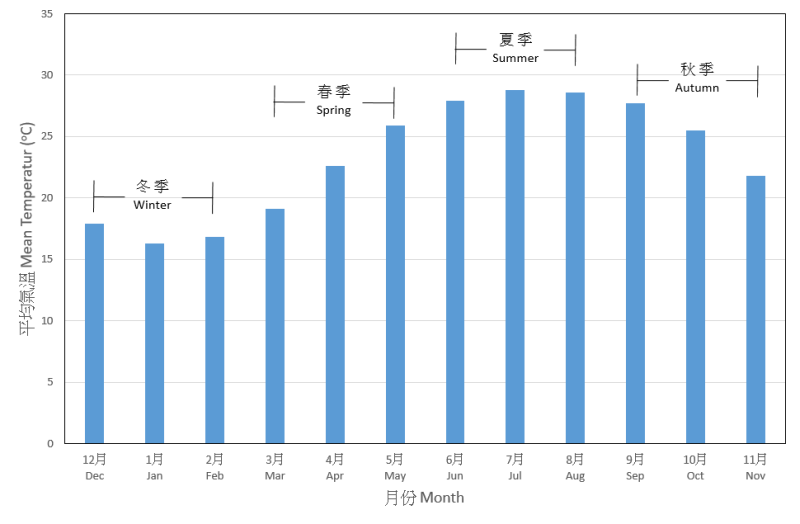
Figure 1. 30-year (1981 - 2010) monthly mean temperatures in Hong Kong.
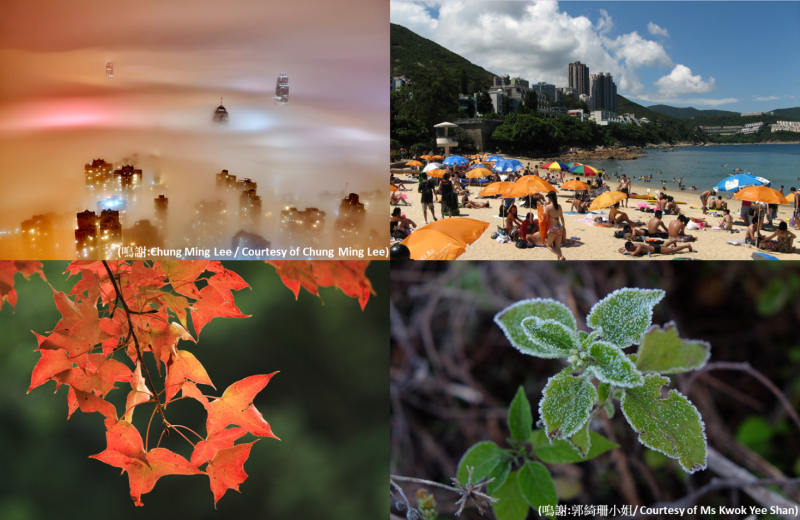
Figure 2. Four seasons in Hong Kong.